

By Reg Brown, Chair of the Insurance Museum
I promised more on the Congress, and this time I’m writing about a speech by J.B. Levison, Vice President of Fireman’s Fund Insurance Company. Mr Levison was asked to speak on the subject “Service Performed by Marine Insurance Companies.” He thought the title was so broad as to put any detailed consideration out of the question in the time allotted so he decided to outline as concisely as possible the history of Marine Insurance, its most important features and “the very important part it has taken in the present great war.”
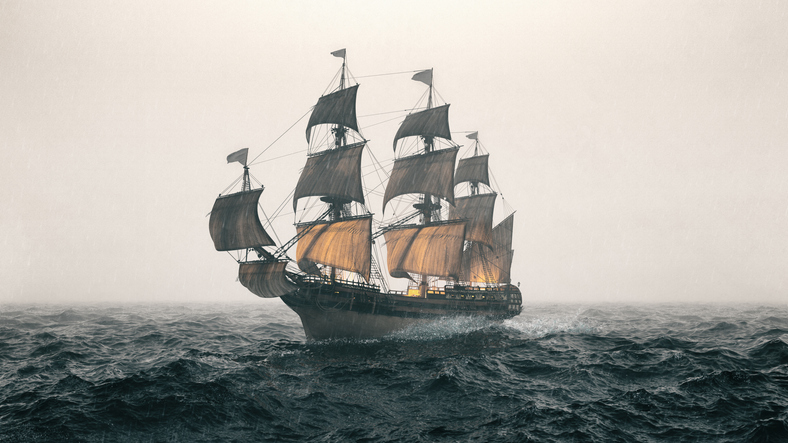
Of particular interest to IM members, he began by asserting that “Marine Insurance is the oldest form of indemnity known. It is generally supposed to have had its beginning contemporaneously with the birth of commercial activity in the Mediterranean about the twelfth century, but unfortunately, little is known respecting its conduct at that time.
English authorities tell us that the Lombards introduced marine insurance into London during the late thirteenth century and a form of policy is described in a Florentine statute of about 1500 AD bearing a remarkable resemblance to the policy which has been in use in London since the latter part of the sixteenth century, when practically all of the countries in Europe established rules and laws for the government of marine insurance.
At that time the business was done altogether by individuals on what we know today as Lloyd’s plan. The first stock companies organized for the transaction of marine insurance business were chartered in England in 1720 and in America in 1792.”
Some interesting facts from the lecture included:
- “Prior to the Civil War, when American mercantile marine was at its zenith, the United States had many more marine insurance companies than Great Britain, but with the disappearance of the American Flag from the high seas the amount of American capital invested in marine insurance decreased until 1905, when there were but three domestic companies doing a marine business exclusively and eleven companies writing marine business in connection with other branches. Today, (i.e.1915) owing to the anticipated development of the American mercantile marine as the result of the completion of the Panama Canal and the general agitation on the subject throughout the country, there are twenty-two American insurance companies engaged in the marine insurance business. It is also an interesting collateral fact that most of the leading British marine offices now in existence were organized in the early sixties, or in other words, during the American Civil War.”
- Since America acquired Alaska in 1869, marine underwriting has been an absolute necessity in the exploitation of the new territory. The dangers of the Alaska coast with inefficient lighting and inadequate aids to navigation required marine underwriters to have sufficient hardihood to undertake the business but high rates and large profits were attractive enough. “Without this protection Alaska never would have become the valuable asset to the United States that it is today.”
- The part marine insurance has played in the present great war must have impressed itself upon all by what has been written on the subject of war risk insurance, the importance of which can best be illustrated by the fact that Great Britain practically on the very day she declared war established a Government War Risk Bureau and called upon some of the leading marine men of Great Britain to direct its affairs. Without this Government Bureau, war risk rates would undoubtedly have been much higher , which was fully warranted by the hazards. High war risk insurance rates would, however, have seriously interfered with British commerce and the British Government, clearly appreciating the commanding importance of this, has, it is believed, been willing to operate the War Risk Bureau, at considerable loss. This loss, however, is nothing compared with the extraordinary cost of the war, especially when the fact is considered that marine insurance companies the world over have thereby been forced to write insurance for British vessels at much lower rates than would otherwise have been the case.”
Mr Levison then went on to explain that many other countries, including the United States, followed Britain’s lead and established their own version for the protection of their own vessels. This, he said, undoubtedly saw commerce between nations stimulated and maintained at a comparatively small cost to the nations themselves.
- Finally, Mr Levison concluded that “no paper on marine insurance would be complete without a reference to the expression “Lloyd’s” which is so frequently used in connection with shipping and underwriting affairs, We are told that it has all come down from one Edward Lloyd, the owner of a coffee house in London about 1690, which was the rendezvous for ship-masters, shipping men and merchants generally during the last half of the seventeenth century and which generally became a central point for all persons connected with shipping. From this simple beginning has developed the use of the word “Lloyd’s” until today it is almost universally understood as having some definite relations to maritime affairs.”
Little did Mr Levison seem to know that only three years earlier, his own company had sought refuge from Lloyd’s because of the large line they had on the Titanic, which sank on 14th April 1912. When the news first broke that the vessel was in trouble, they cabled their reinsurance broker in London, C. T. Bowring, to see if they could reinsure their line. Fortunately, a late arrivals specialist at Lloyd’s, John Povah, was available and took the risk at a rate of 30 guineas per cent. The overnight news meant that Mr Povah knew the vessel was a total loss when he put his line down the following morning.